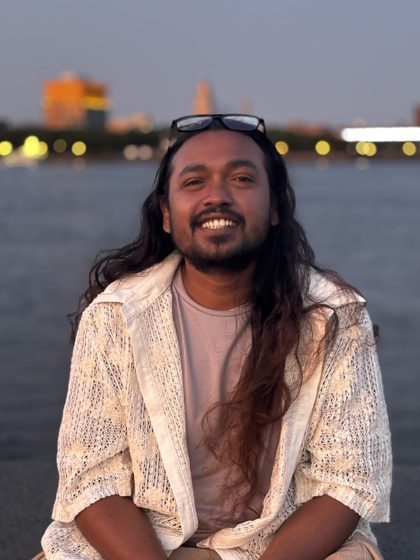
KSHITIJ PATIL
Built for phones and laptops now. Headsets and glasses are next. In a headset browser, look and pinch (or point and squeeze) to tap, and drag to look around.
Creative strategy, brand design, and AI-assisted production for products people actually feel.
I am a creative director and strategist with 8 years across fintech, hospitality, entertainment, and agencies. I started as a communication designer, grew into leading teams, managing agencies, and owning go-to-market calendars, and I now pair that craft with a Master’s in Information Systems (Data Science) from Drexel.
I trained as a communication designer (BFA, Applied Arts) and spent the first half of my career making brand work for entertainment and agency clients. From there I moved in-house at Treebo Hotels and Tata Digital, where I owned content calendars, directed external agencies, led designers and copywriters, and presented brand strategy to senior leadership. Along the way I noticed that the best creative decisions came from understanding the whole system, from audience research to analytics to production workflow, so I completed an MS in Information Systems (Data Science) at Drexel to close the gap between designing an experience and building it. Today I work as a creative strategist and director: I set the idea, build the process around it, brief and QA the team, and use data and AI tools to ship faster without losing craft.
We live in a world where Product decides what we get, Marketing convinces us we needed it all along, and Design makes sure we enjoy every second in between. I’m fascinated by all three, and even more fascinated by the space where they overlap.
I’m looking for a team that’s building something worth obsessing over, especially where I get to own the full client relationship, not just the campaign. If that’s you, let’s talk.
Concept, identity, art direction, campaign systems, and team and agency leadership.
Positioning, messaging, launch calendars, audience research, and stakeholder alignment.
AR build work (FlippAR), AI-integrated workflows (Tata), and CRM and analytics work. Building and testing products, not just designing them.
I’m the kind of curious that gets a little obsessive, especially about experiences that feel designed, not just built. I make personal art to express what I feel and to stay occupied when I am not mentally centered, and I like travel, new places, new cuisines, and meeting new people.
6 PROJECTS · TAP ONE TO OPEN
NeuCard needed to move faster. During IPL 2024, campaigns and acquisition efforts were running on month-long production cycles that cost roughly $5,000 to $8,000 each, and that pace was bottlenecking growth. The in-app experience also needed real usability work, not just visual polish.
I was the designer in a three-person NeuCard vertical, alongside a brand manager and a copywriter. I ran a dual-track marketing calendar, always-on content plus dedicated launch calendars for Tata partner-brand releases, coordinated across product, growth and partner marketing, and aligned stakeholders across Tata's partner brand ecosystem for campaigns spanning stadium, broadcast, web and app.
I worked directly with the product and growth teams to find where the in-app experience was creating friction, then improved those flows. I also identified the production bottleneck and piloted AI-integrated content workflows (LLMs, Midjourney, ChatGPT), documented the workflow so the team could reuse it, and restructured budget cycles into two-week sprints.
Getting to sit at the intersection of product and growth (not just designing what users saw, but influencing how fast the whole team could move) was exactly the kind of cross-functional work I look for.
Delivery and approval cycles dropped from month-long to two weeks, and per-cycle production cost fell from $5,000 to $8,000 down to $1,000 to $1,500, a 75 to 80 percent reduction. The program I worked on contributed to 2M+ active NeuCard cardholders and 12M+ monthly transactions.
Figma, Midjourney, ChatGPT, Adobe Creative Suite, Microsoft 365, Google Ads and Analytics, Meta Ads Manager (as performance data informing direction)
FlippAR was a Bangalore travel-tech startup building augmented reality experiences for tourists: the app needed to turn static monuments and travel moments into something genuinely interactive.
I redesigned the mobile app experience and built several of its signature AR features: a "teleportation sphere" letting users step into a different location entirely, and 3D digital replicas of Indian monuments (some modeled inside and out) that users could place and walk into in AR space. I also built the app's scanner feature, which recognized a monument and surfaced contextual information, including details as specific as a worn inscription or a recently broken feature.
I led on-the-ground user testing, built personas and user stories, and iterated the acceptance criteria as we learned.
Travel and new tech are two of my favorite things, and this let me work on both at once, with a team that was genuinely excited to push what AR could do before most people had a clear idea what it was for.
These were ambitious, technically involved builds for a startup: running design sprints, testing prototypes, and iterating quickly. I secured formal partnerships and compliance sign-off with the Karnataka State Tourism Department and the Bangalore Airport Authority. On the product side I worked with local partners including Seven Oceans, The Bier Library, Higginbothams and Goobe's Book Republic, along with other local shops in Bangalore. The product has since reached 50K+ downloads on Google Play (a product-level figure, not a personal result), covering Hampi, Bangalore and Mysore tourism.
Unity, ARCore, Blender, Figma, Adobe Creative Suite, Invision
Billbolo was a Buy Now Pay Later app built specifically for tier 3 and 4 Indian cities: markets with far less exposure to formal credit and BNPL products than metro users, so the product needed to earn trust and clarity from the very first screen, not just look modern.
I ran market and design research into this user base (how tier 3/4 audiences related to credit, what confused or worried them about BNPL, and where existing apps assumed too much familiarity), then designed the first draft of the onboarding flow and homepage screens around those findings.
Designing for a genuinely underserved, under-researched audience during Covid, when most fintech design was still copy-pasting metro-city patterns, forced me to actually question defaults instead of inheriting them.
The research reshaped some fairly basic assumptions about the onboarding flow: where a metro-first BNPL app might lean on speed, this one needed to lean on clarity and reassurance first, building trust for first-time borrowers. The first-draft onboarding and homepage screens came directly out of that shift.
I also explored accessibility-led concepts, including an always-on WhatsApp support channel and read-aloud page navigation. These were explored, not shipped.
Figma, Adobe Creative Suite
Hearth is a household wellbeing web app, built for Drexel's Human-AI Interaction course (INFO 693). It comes with a companion kids app, Hearth Kids, which uses a device token instead of an account.
I designed and built Hearth together with my teammate Purva Bhawsar. We wireframed it in Figma, then built it on React 19 and Vite with Supabase, coding with Figma Make and Claude Code.
Privacy-safe household sensing, using Supabase row-level security, and an "evidence over verdict" approach to the app's AI interactions.
See it live: Hearth and Hearth Kids
Figma, Figma Make, Claude Code, React 19, Vite, Supabase
Vanguard ID Systems was running sales on an aging, offline system (Salespad) with no real CRM, and previous attempts to fix it, even with outside vendors involved, hadn't worked. The goal was to move to an AI-assisted, cloud-based CRM that could actually handle sales, marketing, and reporting in one place, as part of a wider brand relaunch.
I started by studying the existing data structure (customers, parent companies and their subsidiaries, product quantities, margins) and worked with leadership to decide what mattered enough to carry forward. I rebuilt an equivalent structure in HubSpot, using SQL, then cleaned the underlying data by hand with custom Excel macros before importing it, so the new system launched on data worth trusting instead of the same mess moved somewhere new. I then built revenue and pipeline dashboards for sales and leadership.
Alongside the data work, I owned go-to-market execution for the brand relaunch: competitive research, customer interviews, a content calendar, refreshed marketing assets, and launch-readiness outreach across social, seasonal, and partnership channels. I presented the resulting GTM strategy directly to senior leadership.
I'm a data enthusiast at heart, and this was a genuinely hard puzzle: twenty years of tangled records nobody had wanted to touch. Untangling it into something a whole team could rely on every week was exactly the kind of problem I go looking for.
The data went back to 2006: over two decades of weekly sales records, customer IDs that had drifted or duplicated over time, and errors baked in from an earlier cleanup attempt that had made things worse, not better. AI tools couldn't do the core of this work; too much depended on judgment only a person could make: is this contact still with the company five years later, who owns this account now. In the end, I cleaned and migrated roughly 20,000 records: about five months of accurate, usable history, out of twenty years of corrupt data, with responsible contacts and companies attached.
HubSpot, Salespad, Excel (custom macros), SQL, ChatGPT, draw.io, Google Analytics and Ads
My first job: hired for design sensibility and English fluency, handling two international clients simultaneously: a UX/UI overhaul for a large bank's website, and a privacy-focused family safety app built around a GPS/camera/sensor ecosystem.
For the banking project, I researched competitors and design approaches to shape a UX that would carry across a large number of pages and flows. For the family safety app, I tried out comparable products myself to understand what worked, find the gaps competitors were missing, and design around real privacy considerations for a whole family's experience, not just one user.
Two genuinely different research problems, on my very first job, was a real trial by fire, and a safety product built to protect an entire family was a meaningful thing to be trusted with early on.
Both clients approved the initial proposals, but development constraints stalled things before they shipped. I moved on to a new opportunity shortly after: a decision that opened the door to the FlippAR chapter that followed.
Adobe Creative Suite, Microsoft 365, Invision
11 PROJECTS · TAP ONE TO OPEN
Drive acquisition and brand visibility for NeuCard through faster, more efficient marketing execution, without ballooning cost or timeline.
I created acquisition and promotional assets in collaboration with the growth team, ran design for on-site acquisition booths, and produced interactive PDF assets with live links and animation. I also designed assets for NeuCard's celebratory events and its Forex Card line, and made sure everything stayed consistent with the wider Tata brand ecosystem.
I also directed two external agencies, Changing Tree and Schbang Digital, that produced email, paid and search creatives: I reviewed and approved their work, directed revisions, and ran daily and weekly syncs on campaign performance.
The range was the appeal: one week it's a booth experience, the next it's a brand-consistency exercise across a huge corporate ecosystem. Rarely repetitive.
Introducing AI-assisted asset generation meaningfully reduced production budget and time. Combined with tighter iteration cycles, the team moved from month-long approval chains to two-week cycles, as part of a program that contributed to 2M+ active NeuCard cardholders and 12M+ monthly transactions.
Figma, Midjourney, ChatGPT, Adobe Creative Suite, Microsoft 365, Google Ads and Analytics, Meta Ads Manager (as performance data informing direction)
Scale brand awareness and revenue through performance marketing, while also solving a real reputation problem in Treebo's budget hotel segment, which was collecting poor reviews tied to unavoidable budget-property constraints.
As a senior member of the performance marketing team (social, SEO, brand identity), reporting to the Director and VP of Growth Marketing, I led a team of 5 (2 designers, 2 copywriters and 1 video editor) creating performance assets, handling capacity planning, estimates, timeline checks and delegation, and overseeing the quality and messaging of an external creative agency. I used Meta and Google Ads analytics to learn what offers and visuals actually converted, ran an always-on calendar alongside milestone launches (balancing a steady cadence with real-time, virality-driven posting), and participated in Scrum ceremonies (sprint planning, standups, reviews, retrospectives and backlog grooming). I also hired and trained a junior designer who was later promoted to senior. Treebo's YouTube had stalled: a legacy batch of music-session videos drove views but no bookings, and skippable agency ads weren't landing with an audience actively tuning ads out. I rebuilt the channel around a video-first, micro-influencer strategy and custom travel-trail content, and improved WhatsApp-based communication with shareable PDF guides that hotel owners and travelers could pass along within their own community.
I also made product and UX contributions: I recommended moving the mobile app's filter and search bar from the top of the screen (carried over from the website layout) to the bottom for one-handed use, which was adopted in the live app, and I diagnosed inconsistent, outdated hotel-room photography and defined new photography guidelines (camera angle, lighting, room staging) applied across new properties.
Getting to combine hard performance-marketing numbers with a brand that was actively expanding was a rare mix of analytical rigor and room to try new formats.
The brand grew from roughly 10K to 27K followers during this period, expanded its hotel portfolio, and partnered with major hospitality brands. The YouTube pivot alone drove a 28% year-over-year lift, a 9% rise in repeat bookings, 3.6 million impressions, and 210,000+ direct engagements. (See the separate Itsy by Treebo entry for the budget-tier rebrand from this same period.)
Meta Ads Manager, Google Ads / Analytics, Adobe Creative Suite
Treebo's budget hotel segment, Treebo Trip, was collecting poor reviews tied to unavoidable budget-property constraints and was headed for discontinuation: the tier needed a new identity and positioning that set honest expectations instead of over-promising.
This was a bet I proposed and drove myself, not a brief I was handed. I researched what budget travelers actually valued, then rebuilt the tier's brand from the name up: Treebo Trip became Itsy by Treebo, with positioning and a guidebook redesigned to match. I authored the brand book, a B2B branding framework and a messaging playbook, and presented the brand book and strategy to senior leadership.
Getting to take a segment nobody expected to survive and give it a real second life (end to end, on my own initiative) was exactly the kind of ownership I look for.
The reposition reversed a reputational risk and averted significant portfolio churn, turning a segment headed for discontinuation into a popular one again, contributing to the brand's overall growth from roughly 10K to 27K followers during this period.
Adobe Creative Suite, Meta Ads Manager, Google Ads / Analytics
Launch and market a multi-city comedy festival planned across Mumbai, Delhi and Bangalore, with 100+ comedians and 100+ shows.
Over roughly three months, I built the full design library needed for the campaign (export-ready for digital, print and out-of-home (OOH), meaning social plus banners and flexes), largely solo for the first month before a junior team joined to help execute against the guidelines I'd set.
A genuinely multi-city creative rollout, with real design-system discipline required to keep everything consistent across a huge number of formats and cities.
Testing communications across audience segments taught a real lesson in restraint: banner copy capped at 7–8 words, leading with the comedian's face, outperformed heavier-copy versions for established names: recognition earned the click, copy came second. Budding comedians without that built-in recognition needed the opposite, leaning on copy to carry context a face alone couldn't yet. Momentum was building well behind that insight (strong audience response across social channels) before COVID hit and the physical edition had to be cancelled outright. The work itself held up; the timing didn't.
Adobe Creative Suite, Microsoft 365
Reposition Breezer Vivid Shuffle (BVS), a physical hip-hop battle festival, as a fully virtual Season 4 for a pandemic-era, digital-only audience. It was a free-RSVP event funded by brand sponsorship and ads (Bacardi's Breezer).
As senior designer, I managed a team of junior designers plus an external agency, shifting the brand almost entirely into digital assets: loud fonts, loud music, motion and haptics designed to make static content feel alive on social platforms. My team also edited and processed contestant video/audio submissions for social-ready posting, and handled the extra layer of approvals required for celebrity and brand-ambassador content.
Solving "how do you make a loud, physical, in-person festival feel loud through a phone screen" was a genuinely hard creative problem, and seeing it click for the youth audience it was built for was the best part.
The season scaled from a previous footprint of 5–6 major cities to a fully nationwide, boundary-less open call: thousands of entries narrowed to 96 finalist artists across four specialist crews (rap, hip-hop, breaking, popping, graffiti), fronted by 2 film-star brand ambassadors and 4 celebrity team captains, over roughly 5 months of digital engagement. Running creative tests with the marketing team taught us two concrete things: visuals that gave brand ambassadors the most space outperformed ones balanced toward the team-captain celebrities, and our Instagram AR filters saw more use when kept minimal, since heavier filters lagged and hurt the experience. Heavy back-and-forth with PR teams on celebrity approvals and a steep motion-design learning curve, compressed into a short timeline, came with the territory.
Adobe Creative Suite, Microsoft 365
Praarambh 2.0 was an internal event for Tata Digital employees marking a company milestone: it needed to feel like a genuine celebration, not just a corporate town hall with a stage attached.
I designed the event's visual identity end to end (logo, stage and set design, photobooth, signage, and branded gifting) so the milestone had one consistent look from the moment employees walked in.
Event design is design you get to watch people actually stand inside of and take photos in front of: a different, more immediate kind of feedback than a screen ever gives you.
A full event identity system (logo, stage design, photobooth, signage, and branded merchandise), all used live at the event itself.
Adobe Creative Suite
Manage design and campaign execution for three clients at once (Domino's, the primary account; Rupeek; and OnSiteGo), each with very different brand needs.
Reporting to the Head of Art, I led a team of 5 (three designers and two copywriters), coordinating in-house photo and video production for client campaigns, including month-long shoots with Domino's, alongside daily offer content, while capitalizing on viral cultural moments (the iPhone camera-diagonal joke, Halloween, IPL). Beyond the design work itself, the team shipped 5 to 7 creatives a week across multimedia formats, and I was the primary day-to-day contact for all three accounts, running daily syncs with clients on campaign stats and pipeline to shape what we made next. I handled capacity planning and delegation based on each person's static versus motion strengths, mentored junior designers on editing-tool techniques, and ran design-software challenges to build the team's skills. For Rupeek, a newer brand still defining its identity, my team and I built campaigns around their "Family Man" actor ambassadors while documenting what was working to help solidify their brand guidelines. For OnSiteGo, we used photo manipulation to communicate their service benefits visually.
Three brands, three completely different problems (an established giant needing constant fresh content, a young brand needing definition, a service brand needing visual translation), with a team that was genuinely supportive and all-in.
All three clients were satisfied with the work, and several Domino's posts became viral hits in their own right.
Adobe Creative Suite, Slack, Microsoft 365
MUM needed a full brand identity and early marketing presence for its launch as a fusion-cuisine cloud kitchen in Mumbai: look, voice, and launch plan, all built from nothing.
I led the branding (logo, visual identity, and iterations), then carried that identity into messaging, marketing collateral and a scheduled social content calendar and launch strategy, including launch posts and cultural-moment tie-ins.
Getting to shape a food brand's entire visual identity from a blank page, then immediately see it in use in real marketing, closed a loop that branding work doesn't always get to close.
A finished logo and brand identity, plus a working set of social media templates the kitchen could keep using past launch.
Adobe Creative Suite, Procreate
Castrol needed a high-energy IPL-season campaign that could hold its own during cricket's biggest advertising moment in India, without losing the brand's more technical, performance-driven identity.
Castrol needed caricatures of IPL cricketers for its official #CastrolMatchProtector Instagram activation, a prediction contest tied to Aakash Chopra's live match picks. I led the project from establishing the caricature style through trial rounds to final production, coordinating with the Lowe Lintas team managing the Castrol account.
Working through an agency rather than in-house meant seeing how a legacy brand's identity gets protected and adapted by people who've been stewarding it for years: a different discipline than building something from scratch.
120 unique caricatures, produced by a 3-person team in 1–2 months, powering the official #CastrolMatchProtector campaign throughout IPL season.
Adobe Creative Suite
Set the tone for Peppercontent's market entry through an initial social media campaign: the brand wanted to come across as ambitious, loud, and witty.
I did the market research to define how the brand should differentiate itself, then translated that ambitious/witty positioning into an early social campaign meant to set the tone for everything that followed.
Getting to define a brand's voice, not just its visuals, from close to zero: that kind of blank-page positioning work doesn't come around often.
I had to step away before the project closed, due to a simultaneous opportunity elsewhere. Worth noting: Peppercontent has since gone on to real success and international expansion, a nice validation of the early direction, even without seeing it through myself.
Adobe Creative Suite, Microsoft 365
Heart It Out, a psychologists' organisation, needed a social media presence that could talk about mental health without falling into either clinical distance or performative positivity.
I designed the social media campaign (posts, announcements, and supporting sticker graphics), aiming for a tone that felt warm and human rather than like a brochure.
Mental health content is easy to get wrong in either direction, too clinical or too saccharine: finding a visual voice that avoided both felt like genuinely useful design work, not just decoration.
A full set of social post templates, announcement graphics, and sticker assets that gave the organisation a consistent, approachable presence.
Adobe Creative Suite
5 PERSONAL SERIES · TAP ONE TO OPEN
Trapped is a series about a feeling that has no walls you can point to: the sense of being confined not by a room or a cage, but by expectations, fears, and rules that only hold power because we've agreed they do. Each piece gives that invisible confinement a physical shape: thirteen pieces of people visually trapped in metaphorical boxes their own minds create, who stay inside unless they train their minds out of them.
Every piece started with a single figure and one question: what would it look like if the thing trapping them was as literal as the feeling itself? From there, each illustration found its own visual metaphor for a body caught between what's expected of it and what it actually feels.
It's the closest I've gotten to using art as a diary instead of a deliverable: no client brief, no brand guidelines, just a feeling I kept circling back to until it had a shape.
Procreate
Three scenes about the strange, small connections that happen without a word: a boy coming home to a laptop that seems to wait for him the way a dog waits by the door, a present-day update on an old kind of loyalty; a taxi ride where the driver is somewhere else entirely, and the only thing you actually share is the meter ticking upward between you; a rickshaw ride where driver and passenger catch each other mid-glance, both quietly suspicious of the other for no real reason at all.
Each piece starts from a moment most people forget the second it's over, and asks what it would look like if it actually mattered: connection hiding in the parts of the day nobody thinks to look at twice.
I wanted to prove to myself that a moment doesn't need to be dramatic to be worth painting: sometimes the quietest exchanges are the most honest ones.
Procreate
A small, ongoing set of ladybugs going through whatever the day throws at them (heat, cold, rain) and staying exactly as close through all of it. Love less as a grand gesture, more as just showing up, in every condition.
Same two characters, different weather each time: a simple visual formula that lets the "withstanding it together" idea do all the talking without needing to explain itself.
It's a small, low-stakes way of saying something I actually believe: the strongest kind of love isn't the loudest, it's the one that's just consistently there.
Procreate
A set of four pieces about the strange habits two people pick up from loving each other long enough (inside jokes, shared mannerisms, finishing each other's sentences), reimagined as literal camouflage, two colors blending until you can't tell where one starts and the other ends.
I took a chameleon's actual survival trait (blending in to disappear) and flipped it into something romantic: disappearing into someone else not out of fear, but because you've grown that close.
It's about the specific, unglamorous kind of intimacy that only shows up after a long time with someone: less "love at first sight," more "we've somehow become the same person."
Procreate
A loose collection of scenes where the rules are just slightly off: a giant, gentle sea creature sharing a quiet moonlit moment with a kid on a rooftop, a world where the ordinary logic of things doesn't quite apply. The "wrongness" is the whole point.
Each piece starts with one impossible idea and gets built out just far enough to feel like it could be real, without ever fully explaining itself.
Concept art is the closest thing I have to daydreaming on purpose: no client, no brief, just chasing whatever image showed up first.
Procreate
Got a project, a role, or just want to talk shop? Drop a note and I’ll get back to you.
PHILADELPHIA, PA · OPEN TO RELOCATION
THIS CHAT STAYS UNTIL YOU CLOSE THE PAGE